

 LinkedIn
Smart Bidding cannot know which auctions are worth winning until conversions tell it. That is why a 30-day Google Ads performance guarantee should make you suspicious: the bidding system may still be learning, and the conversions you need to judge it may not have appeared in your reports yet.
The problem is not that Google needs exactly 90 days to do its job. It is that a performance promise has to survive three separate delays: collecting enough conversion signals, adjusting bids in response, and waiting for leads to become business outcomes. I would be wary of anyone promising to halve acquisition costs in four weeks without explaining how they will get through all three.
Keep one example in mind. Say a B2B software company spends $15,000 a month on Google Ads and aims for a $150 cost per acquisition (CPA). At that target, it needs roughly 100 demo requests a month, or about three a day. Launch a campaign or change its bidding setup, and Google may show a familiar status beside the bid strategy: Learning. That label is the beginning of the explanation, not the end.
The Learning label is not a kitchen timer
A common reading of Learning goes like this: endure a rough week, wait for the label to disappear, then judge the campaign on its new numbers. I understand the appeal. A status badge looks much easier to manage than a probability problem.
But Google’s bid strategy documentation describes learning as calibration after changes such as assigning a strategy or modifying its settings. The label does not mean bidding stops, and its disappearance does not certify that the campaign has reached its best possible CPA. Google keeps making decisions in new auctions after the status changes. Meanwhile, late conversions can still alter the performance you thought you had measured.
Treat the badge as a notice about recent change, not a certificate of performance. If our software company sees Eligible after a week, I would not call three-per-day demo volume a settled result on the strength of that word alone. I would check how many of those demos have been recorded, how long they took to arrive, and whether they are the kind the sales team can use.
Start with the decision Smart Bidding makes in each auction
It estimates a chance, not a fixed price for a keyword
When a relevant search triggers an auction, Smart Bidding has to decide how much that opportunity is worth under the campaign’s goal. A central input is its estimate of the chance that a click in that context will convert. The context changes: query, device, location, time and other signals can all matter, as Search Engine Land’s discussion of automated bidding explains.
In our example, imagine the campaign enters 4,000 auctions in a day, wins 120 clicks and gets three demo requests. Those three requests are useful feedback. They are not enough to tell you, with confidence, which combination of query, device and location produced genuine buying intent. A desktop search on Tuesday morning might look promising because it preceded a demo. One demo does not establish that every similar search deserves a bigger bid.
Each conversion helps the model distinguish promising auctions from lookalikes. Until enough outcomes accumulate, its estimates can be noisy. That is the mechanism behind the volatility people call the learning phase; the status label is merely its most visible sign.
Volume changes the pace of learning
Now compare that B2B campaign with an ecommerce account getting 300 checkouts a day. In a week, the ecommerce account sees 2,100 positive outcomes; our software company sees about 21 demo requests at its target pace. The first account gets far more chances to connect auction context with an observed result. The second has to work with thinner feedback, even though both have spent the same seven days on the calendar.
Conversion density matters more than elapsed time. Low volume does not make learning impossible, but it makes confident judgments slower. This is where the kitchen-timer idea fails: seven days of sparse data cannot do the work of seven days of dense data. Nor can a patient account manager create missing conversion signals by staring harder at a dashboard.

Use 50 conversions as a planning check, not a finish line
You will hear versions of a 50 conversions in 30 days rule. The useful part is the arithmetic. At five conversions a day, 50 arrive in about ten days. At one every two days, they take about 100 days. As our earlier piece on why the learning phase may take months argues, a low-volume campaign cannot be made high-volume by choosing a shorter review window.
The misleading part is treating 50 as a switch. The fiftieth conversion does not suddenly make bids reliable, just as the disappearance of Learning does not settle every question about CPA. Conversion quality, delay and the way data is divided among campaigns still matter. I use 50 as a rough prompt to ask whether there is enough feedback to begin judging a pattern, not as a guarantee that learning is complete.
Structure affects that calculation. If you spread the same small pool of demos across six narrow campaigns, each campaign has less feedback to work with. The point of Search Engine Land’s discussion of granular campaign structures is practical here: a tidy-looking account can leave its bidding strategies short of usable data. In our $15,000 example, I would want a reason for every split that makes those roughly 100 monthly demos harder to learn from.
Limited volume calls for diagnosis, not a calendar fix
A constrained strategy can keep serving ads without getting enough useful feedback to improve as you hoped. Google’s status documentation describes limits that can affect bid strategies; a label on its own cannot tell you whether the bottleneck is budget, targets, available searches or something else.
For a niche B2B advertiser, the uncomfortable possibility is that there simply are not many relevant conversions to observe. Waiting another week does not create demand. The practical question is what constrains the flow of useful signals, not how soon you can make the status badge change.
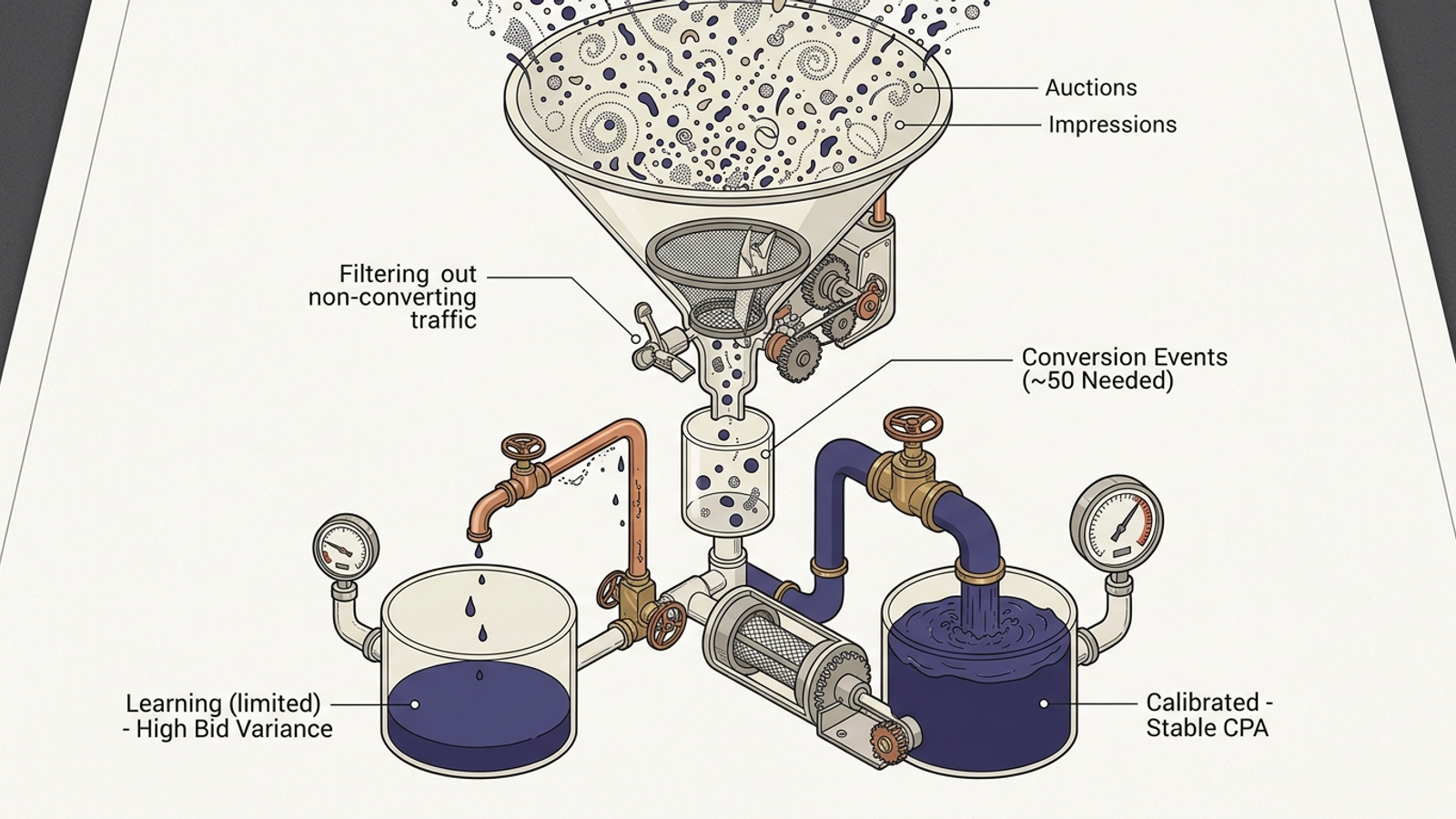
Some changes disrupt learning; others prevent waste
Change the goal and you change the problem
Suppose our software company starts by counting demo requests, then changes its primary conversion action. Or its manager switches bidding strategies and makes a large target CPA change at the same time. The system must adapt to a different goal or set of constraints. Performance may swing while it adjusts. A large budget jump can also push spend into auctions the campaign has had less experience with, a problem practitioners discuss in this r/PPC thread on budget changes.
That does not mean every edit wipes the model’s memory or restarts a precise countdown. It means big changes make the old performance baseline a poorer guide to the new setup. Our account of a learning phase that never seemed to end illustrates the operational trap: repeated, well-intentioned interventions can make it difficult to tell whether bidding is settling or merely reacting to the latest instructions.
I used to treat a bad week as permission to rebuild. Now I ask a less dramatic question first: did the goal, the available budget or the traffic mix actually change enough to explain the numbers?
Do not protect the label at the expense of the budget
The opposite mistake is refusing routine maintenance because the campaign says Learning. If a search term is irrelevant and keeps spending money, add the negative keyword. If a location should not be targeted, exclude it. Fresh headlines and sensible cleanup need not wait for a green badge.
These edits can change which auctions the campaign enters, so I would still watch their effects. But removing obvious waste is not the same as repeatedly changing the bidding goal. If an unrelated software search term is taking $80 a day, I would rather stop that spend than preserve a pristine-looking status while the account pays for clicks it never wanted.
The website can change the math without changing the bid strategy
There is another kind of disruption you may not find in the Google Ads change history. A team redesigns a form, replaces a scheduling widget or makes a landing page slower. If fewer visitors complete a demo request, the relationship between clicks and conversions changes even though the bidding settings stay put.
Imagine the page’s conversion rate falling from 3.5% to 1.2%. Bids based on the previous pattern may now buy clicks that convert less often; reported CPA rises. The bidding system can respond to the outcomes it sees, but it cannot prevent a broken form from losing leads. Before I blame Learning for a sudden spike in CPA, I check whether the conversion path still works.

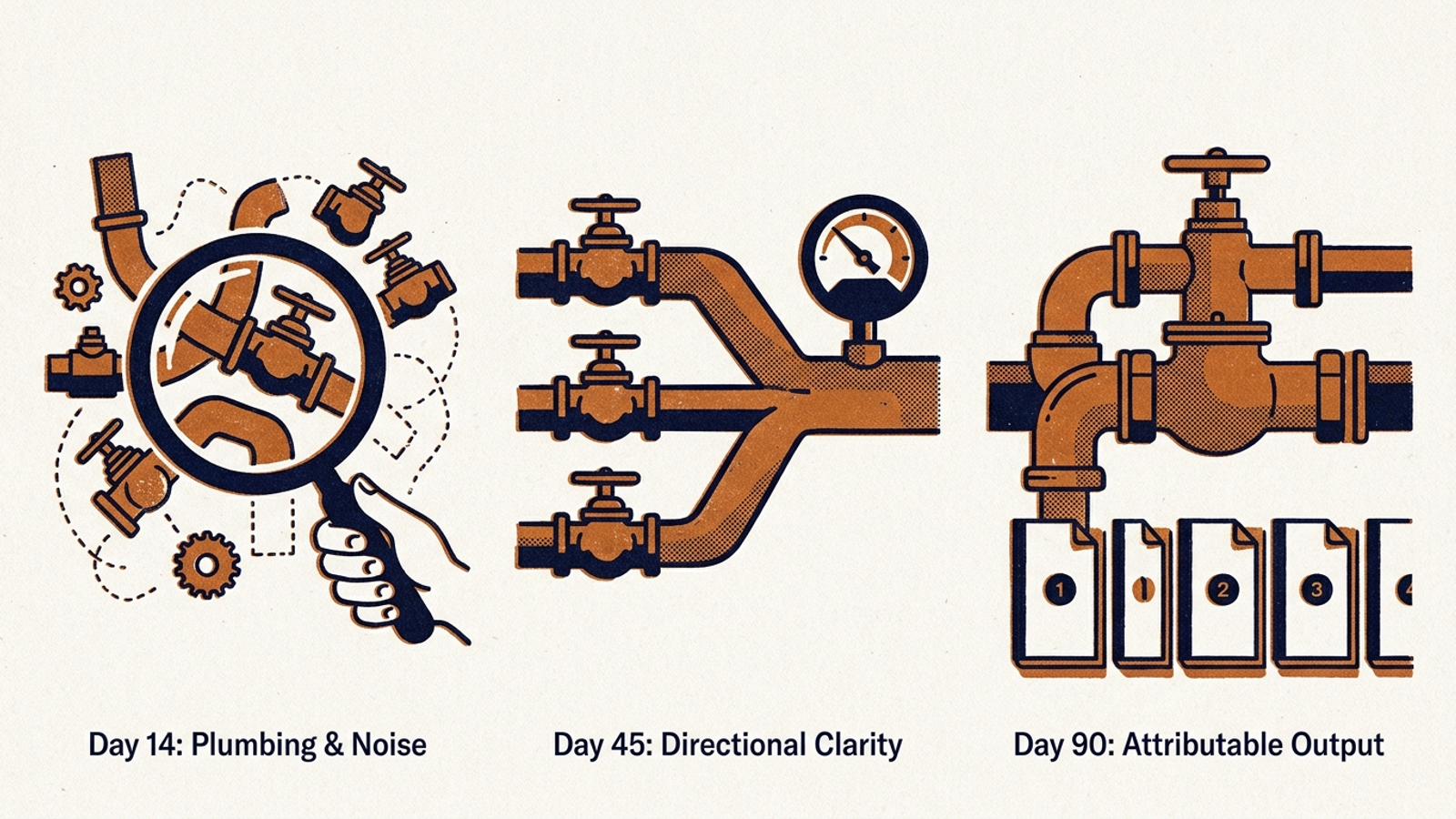
Day 14, day 45 and day 90 answer different questions
Even if the campaign setup stays steady, reporting can lag behind spend. A click costs money when it happens; a prospect may not request a demo until later. Google Ads can attribute that conversion back to the earlier ad interaction, so recent dates may initially look worse than they do after conversions arrive. Discussions of conversion lag in reporting and how advertisers handle that lag describe the same practical headache: the newest data is often the least mature.
For our software campaign, I would give each checkpoint a different job:
- Day 14: check the plumbing. Are demo conversions recorded without obvious duplicate counts? Do search terms reflect commercial intent? Are irrelevant queries being excluded? Two weeks can expose technical mistakes and waste. They cannot, by themselves, establish a durable acquisition cost for a campaign getting about three demos a day.
- Day 45: look for a direction. At the target pace, roughly a month and a half could produce around 150 demo requests before allowing for reporting delays and ordinary variation. That is more feedback than the first fortnight. I would compare mature periods, check whether CPA is moving toward the target, and look for segments that merit careful adjustment. I would not call the business outcome proven.
- Day 90: judge the broader result. Three months give the account more opportunities to encounter different auctions and for delayed conversions to appear. They also give the sales team more time to assess whether demos became qualified pipeline or revenue. Some deals will still be open. The point is to judge with more complete evidence, not to pretend every sales cycle ends on day 90.
Each checkpoint supports a different claim. Day 14 can tell you whether the setup is sound. Day 45 can show a direction. Day 90 is a more credible point for judging whether that direction helped the business.
Why I distrust the 30-day guarantee
A guarantee made before the advertiser has enough conversions, mature reporting and lead-quality feedback has a problem. The seller must either know something unusually specific about the account or rely on a result they cannot yet evaluate properly. I would ask what is being guaranteed: cheaper branded conversions, a platform-reported CPA, qualified pipeline, or revenue? Those are not interchangeable outcomes.
That is why a three-month window makes more sense for the B2B example than a four-week promise. It allows time to collect auction feedback, avoid mistaking late conversions for missing ones, and inspect what happened after the form fill. A 90-day paid ads sprint from groas uses that kind of window rather than pretending a short run of platform numbers settles the business case. Ninety days is a more honest evaluation horizon here, not a magical deadline for performance. If the advertiser’s sales cycle runs longer, even that window cannot turn an open opportunity into closed revenue.
I used to restructure in week two. I was wrong.
Earlier in my career, I watched CPA climb above target after a launch and took it personally. I would jump into the account, pause keywords, split match types, lower targets and reorganize ad groups. It felt like management because I was doing things. Sometimes the account needed a fix. Too often, I had not separated a broken setup from thin data and late conversions before changing the setup again.
The lesson was not never touch a learning campaign. It was to make the intervention fit the evidence. Fix tracking and irrelevant spend promptly. Be much slower to rewrite the bidding goal because two weeks of results made you uncomfortable. Activity is not the same as diagnosis.
Now take a different account: 25 sales a month, with prospects taking roughly three weeks to decide. At that pace, gathering 50 sales would take about two months, and some of the sales from recent clicks would not appear inside a 30-day review. I would inspect tracking and search quality early, wait for older clicks to mature before calling CPA settled, and use a longer window to judge what the spend produced. That is the model, applied without a new rule: count the conversions, account for the delay, then choose the promise. A 30-day guarantee skips the arithmetic.