

 LinkedIn
The agency reports more leads every month. By renewal, your sales team trusts fewer of them, and qualified pipeline has not moved. That is how a search engagement can stall without anyone making a spectacular mistake.
Here is an illustrative version of the pattern, not a named client account: a $4,000 monthly retainer, $60,000 in ad spend over six months, and a slide deck full of improving conversion metrics. The decisions that produce it sound reasonable one at a time. The mistake comes before the first invoice, when client and agency agree to manage campaigns without writing down what qualified pipeline must look like.
The setup: a retainer without a revenue-side target
By June, the client in this composite has paid $24,000 in management fees and $60,000 to Google. The agency can point to a 38% rise in conversions and a drop in cost per lead from $82 to $51. Sales reps, meanwhile, spend their afternoons calling disconnected numbers. Closed-won revenue is flat.
This is not a story about fraud. A catastrophic mistake, such as an extra zero in a daily budget, is easy to spot. The quiet stall is harder: each monthly decision improves the metric the agency reports while leaving the metric the business needs untouched.
The economics make that temptation understandable. A specialist managing multiple accounts has finite time; agency practitioners describe workloads of 10 to 20 accounts. In this version, the account gets 10 to 15 hours of hands-on work a month. That is enough to review bid alerts, check search terms, decline a few auto-applied recommendations, and prepare a report. Reconciling lead quality with the CRM takes a different conversation, and nobody has made that conversation part of the job.
The first thing to inspect is not the dashboard. It is the definition of a win.
Month 1: the conversion is a form fill
The kickoff call goes smoothly. The strategist asks about the ideal customer, collects brand guidelines, requests Google Tag Manager access, and sets up conversion tracking. The interface turns green. Two weeks earlier, though, the master services agreement committed to account setup, weekly monitoring, and monthly reporting. The sales pitch mentioned pipeline; the agreement did not define a pipeline target.
In Google Ads, the primary conversion is a visit to the thank-you page after a standard form submission. A student downloading an eBook and an operations director asking about a commercial rollout each count as one conversion. The bidding system has no reason to prefer the buyer. It has been given two equally valuable signals.
The missing work is a CRM feedback loop and an agreed qualification stage. Google’s Lead-to-Sale Journey Builder distinguishes initial leads from qualified and converted leads. That distinction matters because Smart Bidding trained on cheap form fills learns to seek cheap form fills. It cannot infer from a thank-you page which prospect sales will accept.
An agency might reasonably need time to connect and validate offline conversions. That is different from spending the first quarter treating every submission as proof of progress. Before launch, I would want the revenue-side target in writing and a clear plan for getting qualification data back into the account.
Month 2: the first win looks convincing
Thirty days in, the Slack channel gets a celebratory message: conversions rose from 45 to 68, and cost per lead fell from $82 to $58. The retainer starts to feel justified. The numbers improved; the definition of success did not.
In this version, the specialist has loosened match types, enabled Search Partners, or allowed more automated expansion to find cheaper traffic. More people submit the form. Because the same conversion fires for every submission, unqualified inquiries look just as useful to the bidding system as genuine prospects. Raw lead volume is also an easier agency metric to move and report than sales-accepted pipeline.
None of those campaign changes is inherently wrong. The wrong call is celebrating the lower CPL without checking what came through the form. At this point, the fix is still cheap: sample the leads with sales before calling the month a win.
Month 3: sales stops trusting the leads
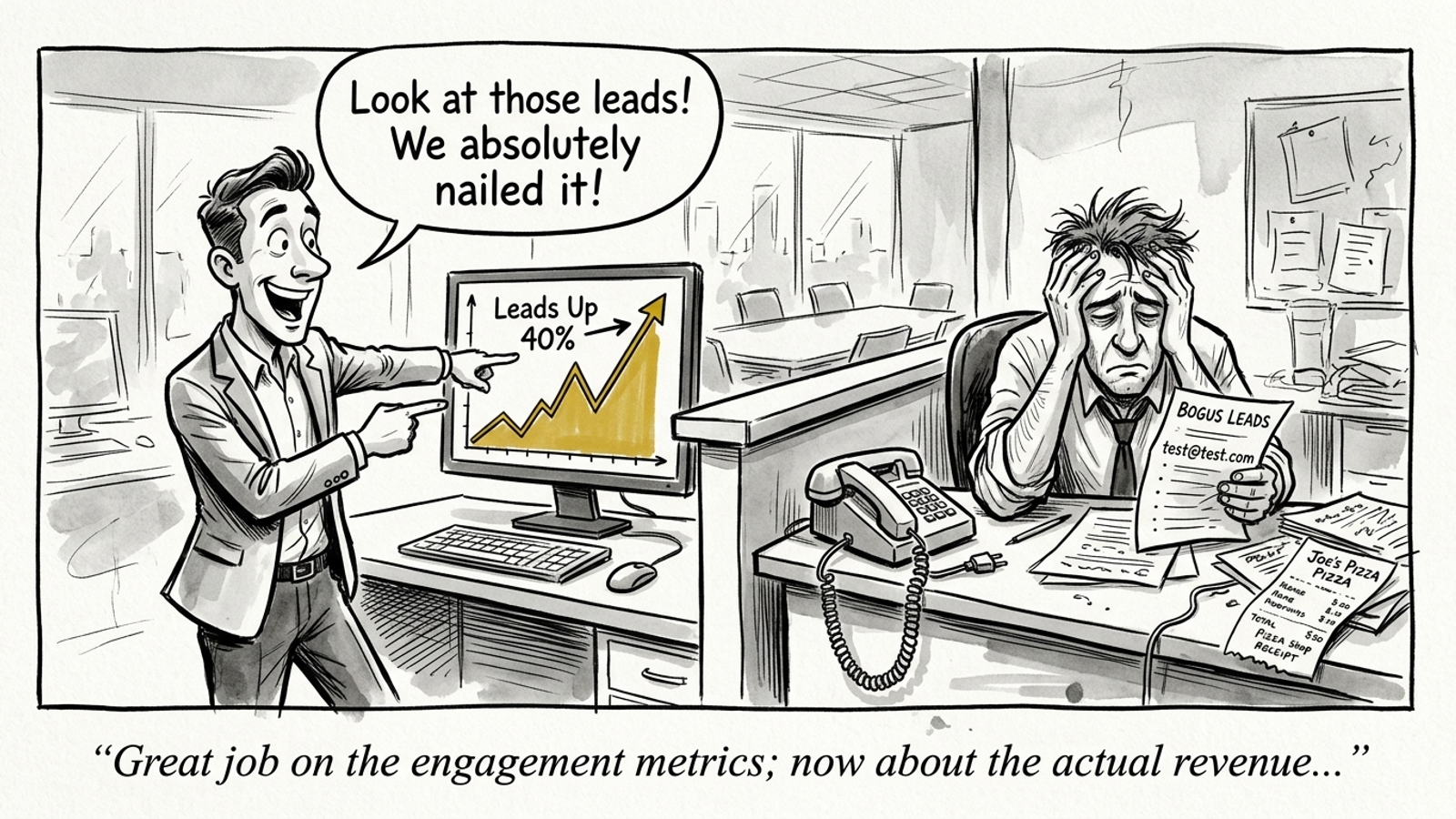
The account logs 120 form submissions in thirty days. At the Monday sales sync, the head of sales supplies the missing breakdown: four became discovery calls, three came from competitors checking prices, twenty-eight have fake phone numbers, and most of the rest are solopreneurs looking for free templates. Reps stop prioritizing ad leads. Calling them feels like cold-calling a phone book.
This is the first unmistakable sign of damage. Sales has qualified the leads, but that judgment is not reaching the bidding system. The agency has not connected CRM stages to Google Ads, so the account keeps learning from submissions rather than from the prospects who advance. Delaying offline conversion uploads can also mean losing the chance to match older clicks back to later sales outcomes; click identifiers and CRM records need a working feedback process.
When the client raises lead quality on the monthly call, the agency replies: “Our job is to generate cost-efficient demand; your sales team’s job is to close it.” That sentence marks the stall. The client thought it was buying progress toward revenue. The agency believes it is delivering the contracted lead metric.
The immediate repair would be to agree which CRM stage counts, then inspect the searches and forms producing the rejects. Negative-match irrelevant queries. Add qualification where the form invites the wrong people in. Those changes may reduce conversions and raise reported CPL. That is the point: fewer credible prospects beat more unusable forms.
Month 4: the report grows as the pipeline stays flat
Month four brings a longer deck, not better leads. The review expands from four slides to sixteen: click-time heatmaps, demographic breakdowns, a chart showing that 35-to-44-year-olds clicked most on Tuesdays, and a page celebrating search impression share. The data may be accurate. It does not answer what happened to qualified opportunities.
Reports heavy on CTR, impression share, and CPL while avoiding pipeline are a useful warning sign. When an agency cannot show how many sales-qualified leads came from the last 100 clicks, twenty charts about the clicks do not close the gap. They decorate it.
The client’s question at this meeting should be short: Which of last month’s paid-search leads did sales accept, and what did they become? If the answer requires another reporting project, the account is still managing toward the wrong finish line.
Month 5: more budget becomes the proposed fix
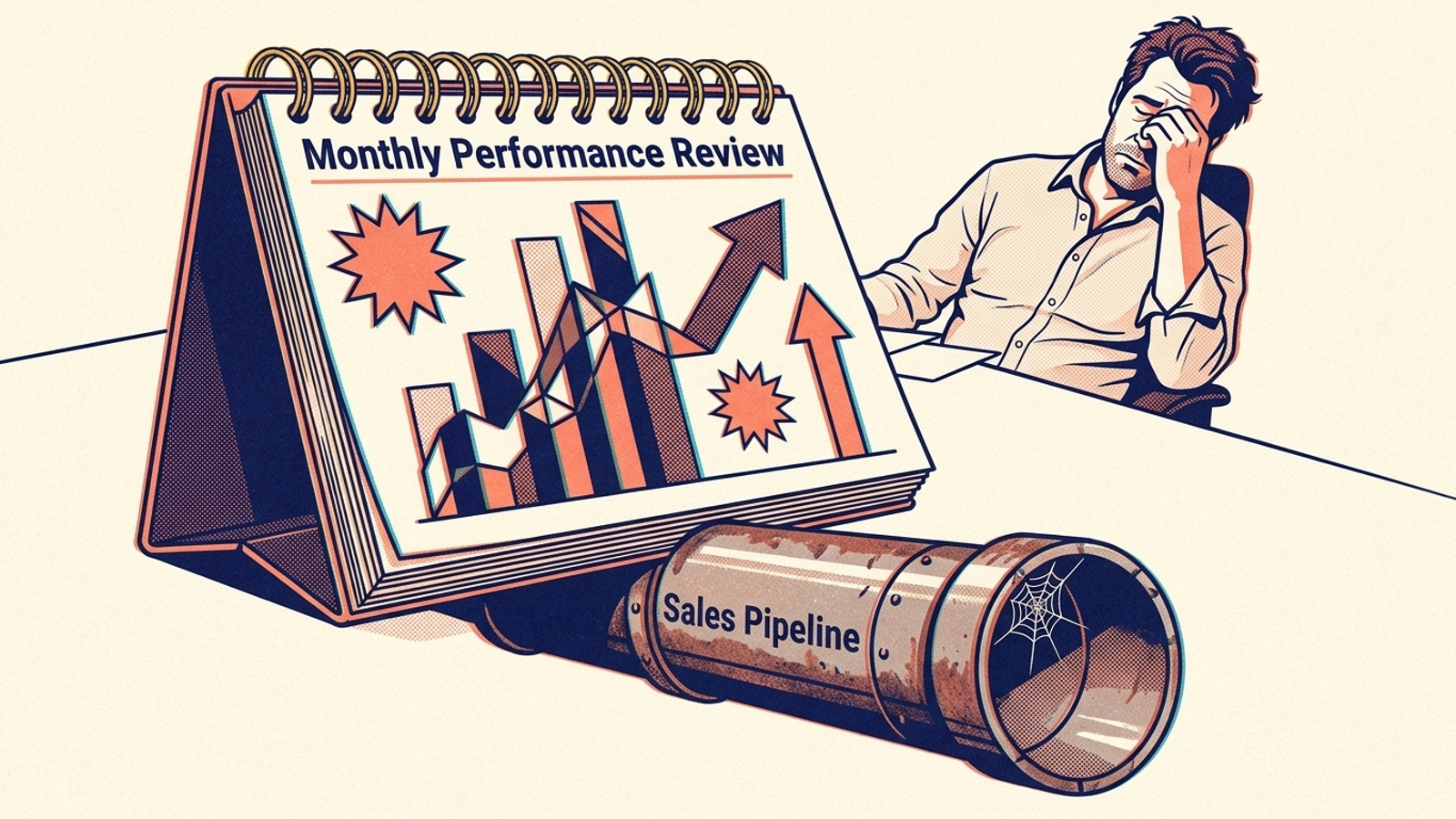
The client pushes again on pipeline. This time the agency points to a “Limited by Budget” warning and says Smart Bidding needs more room to find higher-intent searches. Another $3,000 in monthly ad spend, it argues, will give the campaigns headroom.
That argument has a hole. More budget cannot correct a bad definition of success. If the primary goal remains an unqualified form fill, additional spend gives the system more chances to find people willing to submit that form. It does not tell the system which people can buy. The learning-phase explanation may sound technical, but the missing input is commercial, not merely computational.
The useful question is not whether the account can spend more. It is whether the CRM shows that the current spend produces qualified opportunities. Until the agency can answer that, increasing budget scales the unresolved problem.
Month 6: the renewal deck meets the CRM
The initial term expires, and an account executive schedules the renewal call. The client pulls two views of the same six months.
The agency view leads with an 82% year-over-year increase in conversion volume and proposes a twelve-month renewal with a 15% spend expansion. The CRM view shows 640 total “leads,” 22 discovery calls, four proposals, and two closed-won accounts generating $18,000 in gross margin. Against $24,000 in management fees and $60,000 in ad spend, that is $66,000 more spent than those accounts generated in gross margin. These are illustrative figures, but the mismatch between the two scorecards is the case.
Nobody had to act maliciously to get here. Each month, the agency improved or defended the number it had agreed to manage. Each month, the client waited for those gains to appear in pipeline. The relationship did not implode. It reached renewal with both sides able to say they had been looking at different things all along.
The decision that belonged before the first invoice
At month six, it is tempting to declare search advertising broken or assume the market is too crowded. The record in this composite does not support either conclusion. It shows an engagement that never made qualified pipeline its operating target.
Before the first invoice, the client and agency needed a written definition of the conversion stage that mattered, a baseline, and a target they would review together. That document would not guarantee revenue. It would have made the month-two celebration conditional, forced the month-three sales feedback into the account, and made a month-five budget request answerable against business results rather than form volume.
An operator standard for search work has to connect measurement, query intent, acquisition economics, landing-page qualification, and a visible record of changes. Without that connection, a monthly retainer can pay for diligent campaign activity while the business absorbs the cost of irrelevant demand.
Put the target on the revenue side
The written scorecard can use sales-qualified leads verified in the CRM or a later opportunity stage. If early-stage conversions must remain in the account, give them less weight than prospects who advance. The principle is not that every sale must happen inside Google Ads. It is that a form submission must not masquerade as an equal substitute for a qualified opportunity.
The fee model does not change that requirement. A revenue-share agreement might change how risk is divided; a fixed fee can still come with a clear target and accountability. What cannot work is billing each month while the only agreed success metric stops at a thank-you page. Lead-count incentives can diverge from qualified pipeline unless both sides decide in advance which outcome they will judge.
Give the target a review date and a consequence
A target without a review date can sit in a kickoff deck for six months. Agree on a fixed window, a baseline, and what happens if performance misses. In this illustrative engagement, a 90-day review would have exposed the gap while there was still time to change the campaign. The consequence might be a chance to end the contract without a notice penalty rather than another quarter of testing the same form-fill goal.
The point is not to demand a guaranteed 40% pipeline increase from every search partner. It is to stop treating a rising lead count as sufficient grounds for renewal when the agreed revenue-side measure is flat. Make the consequence legible before anyone asks for patience.
Before leaving, take the account with you
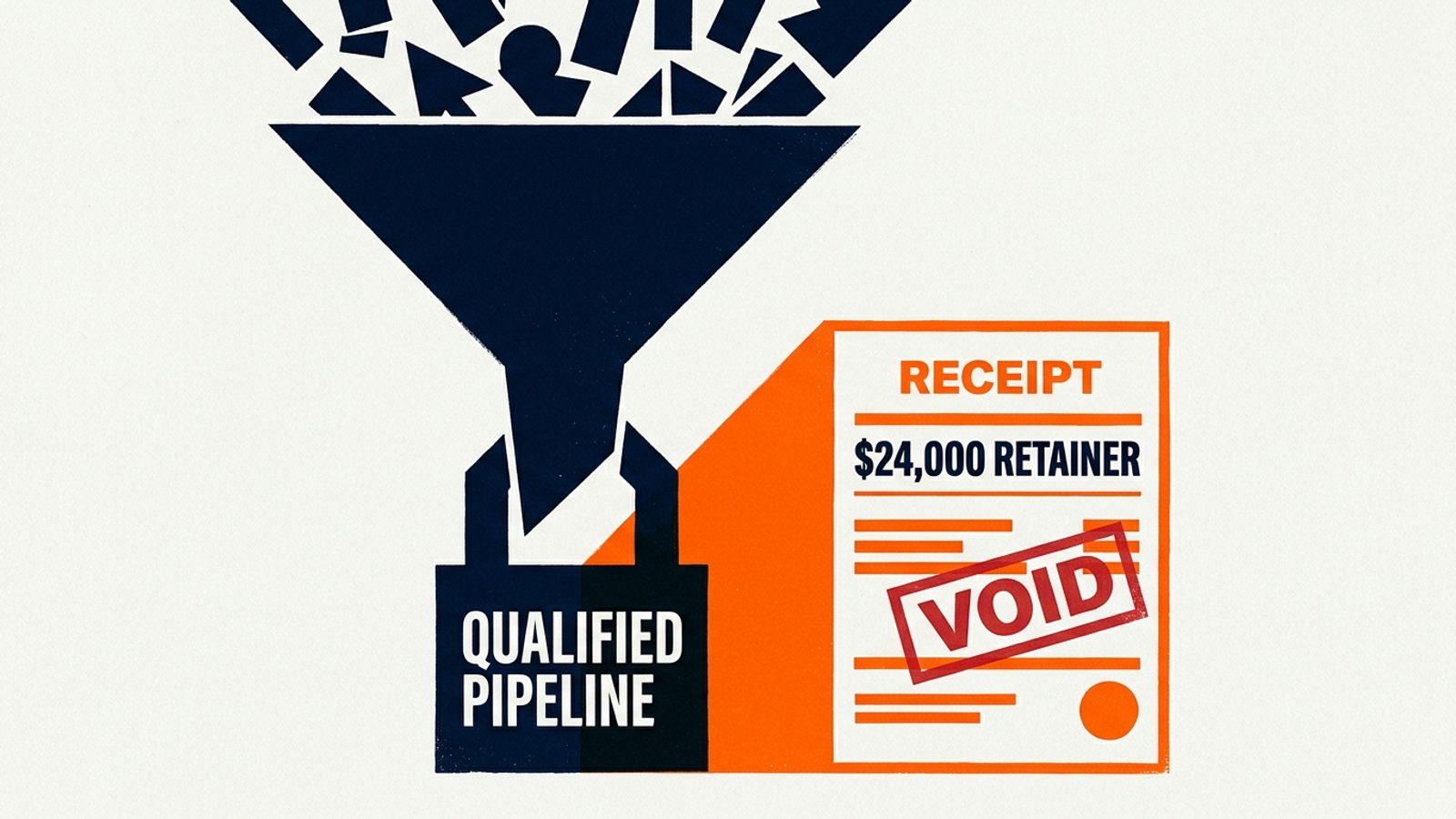
If the renewal agreement is already on your desk, do not terminate over a phone call before checking access. Confirm administrative ownership of the advertising and measurement accounts before offboarding. Campaign history and tracking work are hard to reconstruct after access disappears.
Use this order:
- Check administrative rights. Confirm that a company-controlled email has direct admin access to Google Ads, GA4, Google Tag Manager, and, if you use it, Google Merchant Center.
- Export campaign history. Save campaign backups through Google Ads Editor, along with search-term reports, negative keyword lists, audience exclusions, and available change history. The next manager should not have to rediscover the same irrelevant queries.
- Archive landing-page assets. Save pages, form destinations, and tracking scripts hosted or managed by the agency. Check the agreement before assuming an agency-hosted asset transfers with the ad account.
- Remove agency access after the handover. Once company-owned access and needed assets are secure, unlink the manager account and verify that campaigns and tracking still work.
Secure the history before you change the relationship. An angry offboarding call is not a backup strategy.
Is AI the better replacement?
The obvious month-six reaction is to fire the agency, buy a self-serve AI tool, and let it run. I would not do that with this account as configured. Automation working from broken conversion tracking can pursue the wrong outcome faster. Give it a thank-you page as the goal, and it will have the same missing information the agency had.
The choice between in-house and autonomous Google Ads management starts with the data. If sales stages are mapped and the offer is clear, continuous execution can replace a lot of periodic campaign maintenance. If qualification is still a mystery, changing operators does not solve it. It gives the mystery a new dashboard.
That distinction is where groas makes more sense than another passive retainer: specialized models handle ongoing search execution, while a named human strategist sets direction and guardrails. The model is built around measurable actions and business outcomes rather than paying for hours spent looking at an account. It still needs the same honest input this agency engagement lacked: a definition of the qualified opportunity before optimization begins.
If you are in month six with more leads and flat pipeline, do not buy another quarter on the strength of a prettier report. The single rule I apply to a search engagement now is this: write down the qualified-pipeline target, its review date, and the consequence for missing it before the first management invoice.