

 LinkedIn
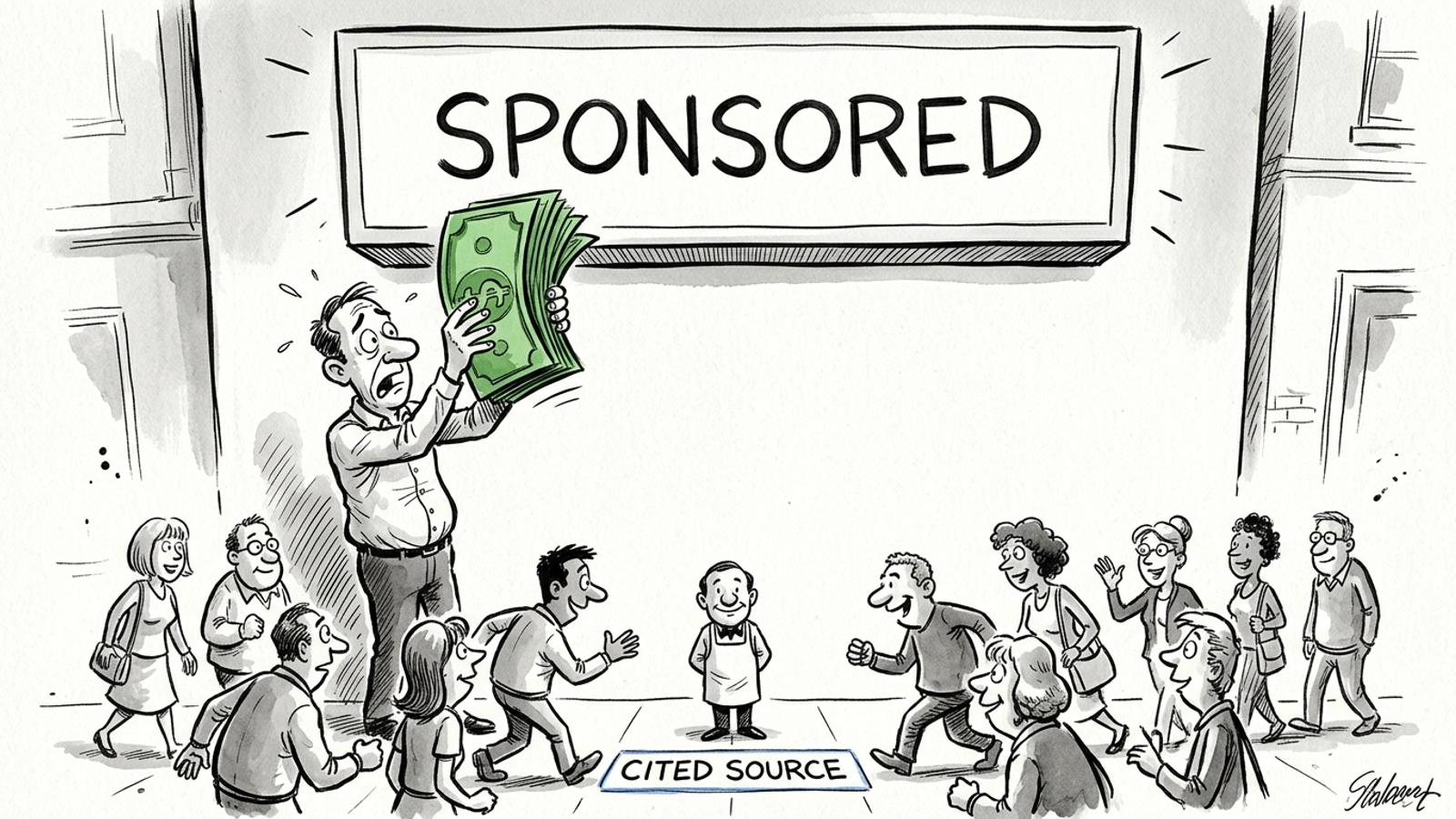
By December 2027, a paid click from a Google AI Overview will cost less than the margin a rival earns from a click on the cited source below it. The ad will be the cheap seat. The name the answer uses as proof will be the one brands fight to occupy.
Google rolled out ads inside AI Overviews on US mobile in October 2024, then pushed Search and Shopping ads into Overviews on desktop at Marketing Live 2025. The ad is automatic if you run the right campaign types. The citation is not automatic for anyone. As paid inventory expands, I expect the price of the sponsored click to face pressure that the limited space for cited sources does not. Brands waiting for an “AI Overview ads” budget line will keep buying a position beside competitors the answer has already endorsed.
I used to tell clients new ad inventory stays expensive for years. I was wrong. Here are five predictions, each checkable by December 2027, with the mechanism behind it and a test that could prove me wrong. No “only time will tell.” If the tests miss, I miss.
Prediction 1: Answers will make less room for sources than for ads
The cause is screen space. An answer holds only so many lines before people stop scrolling. The median scroll depth inside an AI Overview was 30% in a 70-person UX study. Google can add a second sponsored card more easily than it can persuade someone to read a sixth citation. Advertisers running Performance Max, Shopping, and Search on broad match including AI Max are automatically eligible for those placements. More eligible ads do not require advertisers to build a new campaign. More attention for source links requires something much harder: a person continuing to scroll.
That does not mean every Overview will turn into a wall of ads. It means the scarce part of a commercial answer is the space a source can occupy and a buyer might notice. Those are not the same thing. A link that exists below the point where most readers stop is technically a citation and practically a footnote.
How you will know I was wrong: Pull 50 commercial queries now, then the same queries in December 2027. Count unique cited domains and paid units in each answer. If the median answer cites the same number of unique domains or more while ad units stay flat at one, I called the direction backwards. Do not rely on a screenshot of one crowded result. Count the same queries twice.
Prediction 2: The cited brand will take clicks the neighboring advertiser paid to pursue
The mechanism is trust. Pew tracked about 69,000 searches and found that a classic result gets clicked on 8% of visits with an AI summary versus 15% without. Links inside the summary get clicked on just 1% of visits. Read that alone and you would conclude that nobody wins the click once the answer appears.
Then Seer looked at 53 brands and 2.43 billion impressions in April 2026 and found a different split: cited pages earned about 120% more organic clicks per impression than uncited pages on the same query, 2.07% versus 0.94%. Their paid click rates were 15.74% versus 11.19%. Being cited did not undo the broader loss of clicks when an answer appeared; organic clicks were still down 38%. But inside that harder environment, being named beat being absent.
That evidence does not show that a citation already outclicks the ad beside it. My prediction goes further: on the same commercial question, buyers will scroll past the card labeled sponsored and choose the name the answer just treated as proof often enough to make that earned position more valuable. I have watched the reflex in old shopping tests where a review site outpulled the brand ad sitting above it. Same instinct, new layout. The thing to measure is not total AI Overview traffic. It is what happens when an ad and a cited source compete on the same question.
How you will know I was wrong: Compare paid-unit clicks and cited-link clicks on the same commercial queries across a clean holdout through December 2027. If paid units hold equal or higher click-through than cited organic links, the trust gap I expect did not appear. If you are weighing that trade-off now, Can You Buy AI Visibility? Seven Questions Business Owners Keep Asking frames the buy-versus-earn decision the way I would on a call.
Prediction 3: Early citations will become hard to dislodge
The mechanism is parsing cost. Give an engine a page with clear headings, a direct answer near the top, and HTML it can slice without guessing, and that page is easier to use than ten sloppy alternatives. Once it has a workable source, I expect it to return to that source. The easy quote becomes the incumbent.
Classic rank and citation are already pulling apart. Ahrefs tracked 863,000 SERPs and 4 million URLs and found that 76.1% of AI Overview citations ranked top 10 in July 2025, but only 37.9% did by March 2026. Query fan-out can take an answer to pages a classic result never surfaced. That shift does not, by itself, prove that a cited page stays cited. It does tell me that watching your old ranking report is no longer enough to know which sources an answer uses.
There is an uncomfortable operating consequence. If you rank for a short head term but a competitor supplies the clean answer to the question a buyer asks next, your ranking is not a consolation prize. It is a view of the wrong contest. Make your page easy to quote before the same competitor becomes the familiar source for that question.
How you will know I was wrong: Track the cited domains for 20 buyer questions in your category every month through 2027. If more than half of those questions change cited domains every month, there is no meaningful stickiness and I overstated it. If the same two or three domains keep appearing, treat those names as incumbents, not as a one-off search result. Save the domains each month; memory is a terrible citation tracker.
Prediction 4: ChatGPT and Perplexity will reuse the same industry sources
The mechanism is authority reuse. These engines do not want to verify a plumber in Phoenix from scratch on every prompt. They lean on pages that already gather proof: best-of lists, review publishers, and docs that get updated. Ahrefs looked at 26,283 ChatGPT source URLs and found 43.8% of product-query citations came from best-of lists on high-authority domains, with 79.1% of those pages updated in 2025. SE Ranking found Domain Trust 90-plus sites earn about four times the citations.
That is evidence of concentration, not proof that two engines already choose identical links. I expect that concentration to produce overlap. When a trusted page answers a buying question cleanly, more than one engine has a reason to use it. What the deck calls “fragmentation,” I call three bouncers checking the same ID.
This changes where I would spend the next hour. Another post on your own site might help, but an updated mention on a source the engines already use could put your name in front of the buyer without making your site the cited domain. First identify the sources that recur; then decide whether your missing piece is a better page, an off-site mention, or both. For the engine-by-engine view, ChatGPT vs Perplexity vs Google AI Overviews: Where to Earn Citations First maps where to start.
How you will know I was wrong: Sample 30 buying questions in your category in ChatGPT and Perplexity in December 2027. If fewer than half share at least one cited domain between the two engines, sources stayed scattered and I missed. Do not count a brand mention as a shared citation. Check the domains each answer actually links.
Prediction 5: Citation visibility will sit next to CPA on the scorecard
The mechanism is budget defense. When an answer sits between your ad and the click, CPA alone cannot tell you whether the ad failed or the answer took the click. Finance will ask why paid clicks fell while pipeline held. “The Overview did it” will not pass without a second set of numbers.
The reporting pieces are starting to appear. GA4 now carries an AI Assistant channel group. Referral traffic is one piece; a useful visibility ledger also records mentions, citations, position in the answer, share of voice against competitors, sentiment, prompt coverage, and crawl-to-refer ratio. I ran accounts when we tracked calls on a separate sheet because AdWords could not see them. Same pattern. A second ledger appears when the first one cannot explain what happened.
The paid side of AI chat makes the accounting problem harder, not simpler. ChatGPT was the only live self-serve AI ad product in May 2026 at $3 to $5 CPCs and about $25 CPM with a $50,000 minimum, while Perplexity shut its sponsored-answers test in February 2026 and Claude stayed explicitly ad-free. Say you spend $20k a month. You cannot judge a $4 ChatGPT click with a Google branded-search CPA and call it a day. Put cost per cited answer, referral share, and downstream close rate beside paid CPA and ROAS. Otherwise you can see the bill but not the reason the buyer arrived.
How you will know I was wrong: Look at mid-market reports in December 2027. If most still show only CPA and ROAS, with no prompt-coverage or share-of-voice tab, buyers never demanded the second ledger and I overestimated the pain. A prettier traffic chart does not count. I mean a recurring record of which answers name you and which name someone else.
What I would do this quarter if I were you
Start with the buyer questions where you are absent. Pull your last 90 days of Search Console queries, your sales call notes, and the five questions prospects ask before they sign. Run each question through Google, ChatGPT, and Perplexity. Write down who gets cited, not just who ranks.
Most businesses find the same pattern I found on a home services account last year: they rank on page one for the head term and appear nowhere in the answer to the longer question that precedes the purchase. That gap is the work list. Twenty questions, three engines, one sheet. Anything you do before that sheet exists is guessing. Keep the ad cards in the sheet too. If the same rival appears as a cited source beside your paid placement, you have found the contest this piece is about.
Then work in this order:
- Check access. Before writing another page, make sure the engines you want citations from can read the site. Before You Write for ChatGPT, Check Whether AI Can Read Your Site is the place to start. Half the sites I look at still block the crawlers they want citations from.
- Fix the pages you have. Give each buyer question a page with the direct answer in the first 80 words, clean H2s that match the question wording, and facts in sentences short enough to quote. Fix structure before you commission another pile of copy.
- Build the off-site proof. Look at the sources your sheet shows the engines already trust. One updated best-of placement or trade mention on one of those domains can move citation share faster than four new blog posts on your own site.
- Keep paid coverage honest. There is no separate AI Overview campaign to build. Those placements follow existing Search, Shopping, and Performance Max coverage, so keep one eligible campaign per intent cluster, watch the search terms that trigger answers weekly, and cut the waste when it appears.
This is not a request to stop buying clicks while you wait to earn citations. It is a request to stop treating the paid card and the answer below it as separate budgets with separate owners. groas runs that loop around the clock across paid ads and organic search together. The point is to see when the two sides compete for the same buyer, then act rather than admire the dashboard.
Who should ignore all of this
This will not work for everyone, and here is who should skip it:
- If you sell a low-consideration impulse buy under $30 where nobody reads answers, keep buying the click and ignore citations.
- If 70% or more of your paid spend is pure branded search from people who already chose you, the Overview rearranges little for you.
- If you operate in a tightly regulated category where engines refuse to cite commercial pages and default to government sources, no amount of structure will make you the quoted source by December.
If you are not in those buckets, the math can flip. A cited competitor can collect the click you paid to sit next to. I kept monthly scorecards for years where the loser was not the brand with the worse ad. It was the brand with the thinner proof. That gap used to cost you position three instead of position two. In an answer, it costs you presence itself.
On Monday, open the sheet with your 20 money questions and run them. Save the cited domains, the ad cards, and your rank. That snapshot is your baseline. Check it again in December 2027. If I am right on three of five predictions, the citation was the scarce asset all along, and the brands that waited for an “AI Overview ads” budget line paid to sit beside competitors the answer had already chosen.